
Let's be honest for a second.
To a CEO, on the other hand, an “AI Guru” is currently attempting to persuade them that they must use the largest and most costly model available (pat you on the back, GPT-4o) to sort through a few emails.
It is the online version of bringing a gallon of milk using a Formula 1 car. Sure, the engine sounds unbelievable, and you look like a show-off doing it, but you are squandering high-octane fuel to do a job that would be better (and less expensive) with a Honda Civic. It is terribly inefficient, and it is actually excessive. We are allergic to hype at Scaleopal. We feel in creating solutions that in fact make sense to your P&L, and at this moment, the intelligent money is not on the bigger AI. It is on Small Language Models (SLMs).
I. What is a Small Language Model and Why Does it Matter?
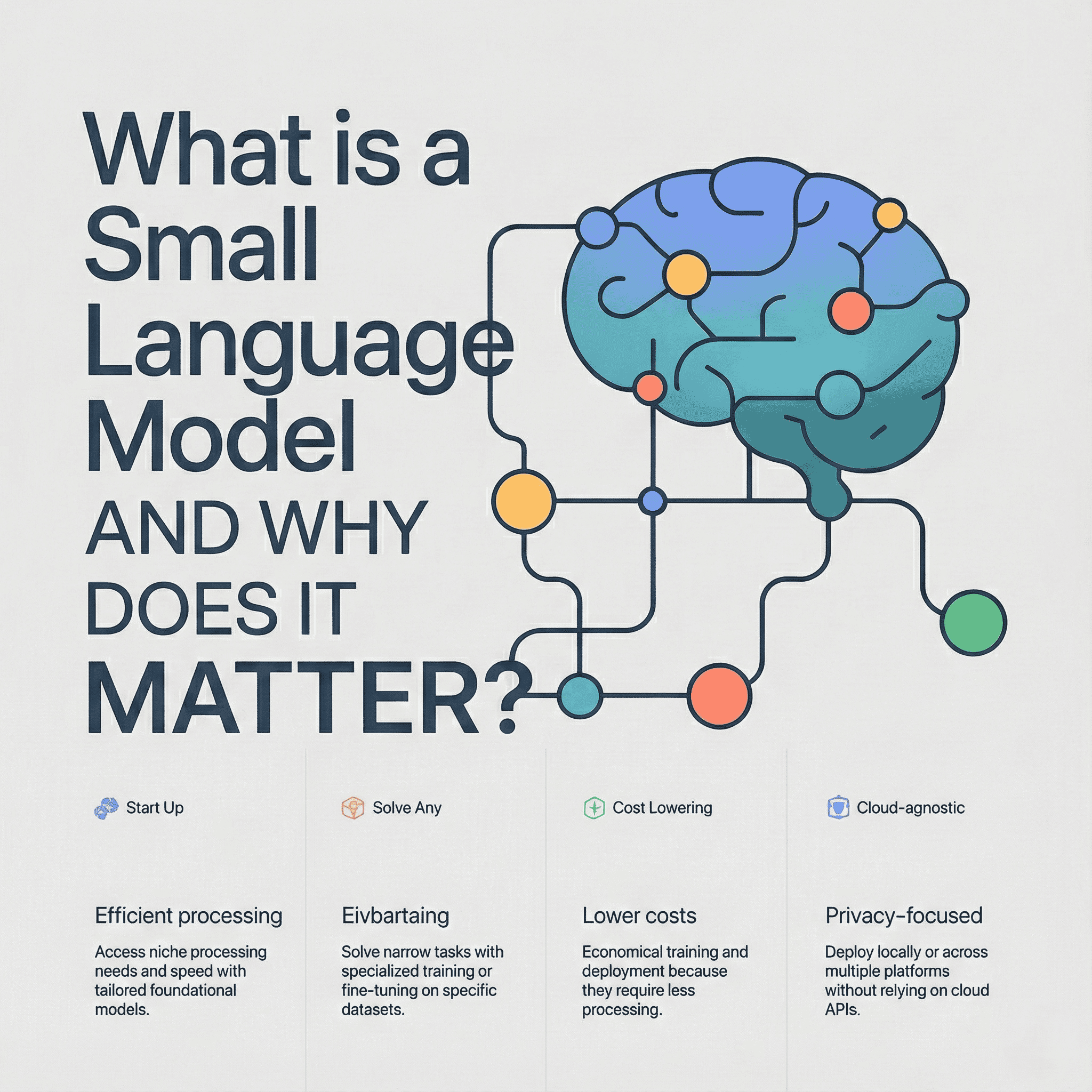
To know the reason why smaller is better, you must see how the gigantic models operate. An enormous Large Language Model (LLM) is an equivalent of a General Contractor. They are familiar with a modicum of all things, such as French poetry, quantum physics, the history of the Roman Empire, and Python code. However, do you need a General contractor to repair a leaky faucet? No. You need a plumber.
Small Language Model Now that you have been nodding your head whenever people mention SLM without knowing even what it means, this is your cheat card: Small language models or compact language models are artificial intelligence language models designed for human natural language processing, including language and text generation. They are smaller in scale and scope than large language models.
Small language models, on the other hand, use far fewer parameters, typically ranging from a few thousand to a few hundred million. This makes them more feasible to train and host in resource-constrained environments, such as a single computer or even a mobile device. Most contemporary (2020s) small language models use the same architecture as a large language model, but with a smaller parameter count and sometimes lower arithmetic precision.
In contrast to their massive brothers and sisters, SLMs are lean AI computers that are only specialists in doing a particular task, not all-knowing in general knowledge. They have fewer parameters, i.e., less computing power to operate, and can be optimized to have a competitive edge over giants in a particular niche.
II. Small Language Model v/s Large Language Model.
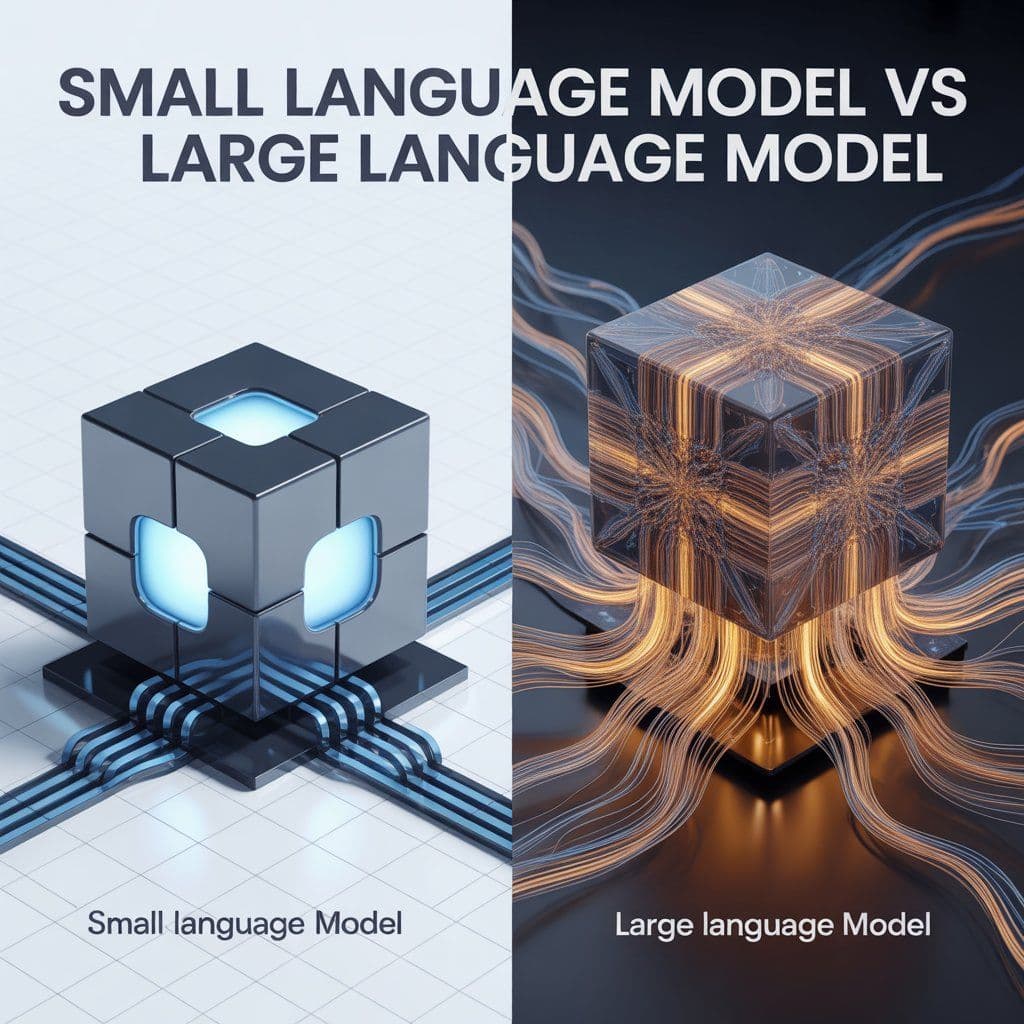
In the comparison of a Small Language Model and a Large Language Model, we are not only different in size, but also in our focus. The internet distracts giant public models. They are perfect in brainstorming and awful in terms of privacy and cost effectiveness. Those specialists are SLMs (think models such as Llama 3 or Phi-3). They do not have to know the capital of each and every country in the world; they only have to be brilliant at their particular job. It can be the examination of the reports of the agency involved in analysis, or the processing of lead operations, but a precision fine-tuned mini-model is always the one that comes out on top in terms of speed and accuracy.
III. Merits of using Small Language Models

It is the section where the Bigger is Better crowd runs silent. Three enormous Benefits of Small Language Model Adoption? A]. True Data Sovereignty: Giant public models are on public servers. You are using a third-party API each time you submit confidential information of your clients to them. In the case of SLMs, we apply Sovereign AI -training models in your own local infrastructure. You will never lose your financial information and customer secrets. B] Cost Control: You use very big models to handle little jobs; you are a Token Burner. Making a small model execute a task that costs the API billions of dollars monthly? Why pay a billion to have a small model perform a task? C] Speed: Smaller models are faster and thus have less latency in operating real-time applications such as chatbots or lead qualifiers.
VI. How Are Small Language Models Developed and Optimized

The magic of engineering occurs in this. What Are the Small Language Model Teaching Paradigms?
We do not simply put ChatGPT in a trenchcoat and call it a day. We are doing the bare minimum of wrapping ChatGPT and calling it a day. We use the open-source base models available (such as Llama 3) and apply state-of-the-art methods of fine-tuning, such as LoRA (Low-Rank Adaptation) and QLoRA.
You provide the data and brand voice of your agency in training the model. The outcome is a proprietary asset that is imitating your writing style, and it is cognizant of your particular business logic, without requiring a giant server farm to operate.
V. Where Can Small Language Models Make a Real-World Impact
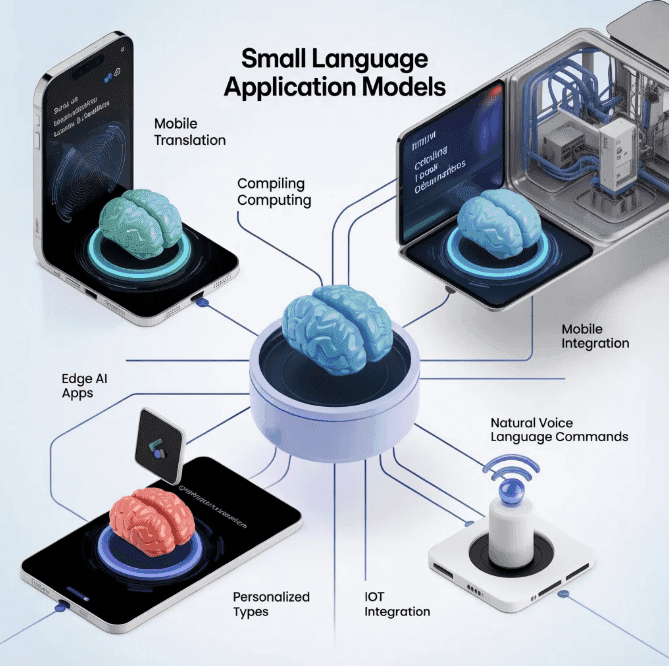
Where do Small Language Models (SLMs), then, really shine, as a difference they bring into the real world? In my opinion, as an engineer working in AI solutions, it is just about exploiting their inherent efficiencies and niche abilities in practical, high-impact situations. In contrast to their bigger counterparts, SLMs are not attempting to address all of the issues simultaneously; they are designed to work in resource-limited or real-time contexts.
-
Enabling On-Device and Edge Computing. Another strong SLM application is in edge computing and on-device computing. Consider the objects we interact with on a daily basis: smartphones, wearables, IoT sensors, and even industrial equipment. They usually have low processing power, low memory, and low battery life. Implementing an SLM on these devices directly implies that AI can operate on them without needing to be connected to the cloud at all times. On-compiler Apps offer great privacy to the user and decrease the latency. Think of a voice assistant that can respond to your commands in real-time on your phone, or a security camera that can analyze the video feeds without sending all the data to the cloud. This localization processing is a game-changer with regard to speed and sovereignty over data.
-
Transforming Real-Time Interactions. SLMs are essential when it comes to situations that require urgent action. Low-latency and high inference rates of the SLM are of great value to real-time applications such as customer service chatbots, real-time language translation, or custom content filtering. We are discussing a smooth user experience whereby time wastage is reduced, interactions are smooth, and receptive. SLMs are faster in offering automated customer service and deliver fast and precise responses without the expense of larger models.
-
Specialized Tasks with Domain-Specific Datasets LLMs strive to be general, SLMs are specific. They are also supra-effective when taught specific domain-related data, and they can be effectively and accurately used to carry out specific tasks. In the case of agencies, it will create a new world of opportunities by developing proprietary white-label AI solutions. Imagine an SLM optimized on legal text to generate a summary of contracts, or one that has been trained on medical texts to help in diagnoses. This custom strategy implies that agencies have the ability to develop specific AI solutions that would respond to the needs of niche clients with accuracy. We use this capability at Scaleopal to design customized models and RAG pipelines to provide specialized intelligence that can be marketed by our agency clients as their intellectual property. The tasks that need efficiency and sophisticated functionality are best suited to Small Language Models (SLM), emphasized by such platforms as MicrosoftAzure. Concentrating on these particular applications, SLMs can provide an excellent combination of performance, affordability, and operational flexibility. Not only smaller LLMs, but designed to have a specific impact and efficiency.
VI. What Cloud Platforms Provide Small Language Model APIs for Developers?
So, where do these things live? What Cloud services provide access to small language models? Whereas the giants would prefer that you remain within their ecosystems, we run SLMs on independent, cost-effective infrastructure, such as RunPod or on private cloud servers. This enables us to choose the Cheapest Viable Model to your requirements so that you are not paying a stupidity tax on computer power which you are not utilising.
The Bottom Line The future of the automation of the agencies is not in the number of parameters. It is a question of whose setup is the most specific, economical, and safe. Therefore, quit trying to make toast with a nuclear reactor. We will make you a toaster, perfectly functioning, and pennies to operate, and place it somewhere inside your own kitchen, where it won't blow up.